News and Analysis

  • A road through BelRed’s new park? 

    If you’ve been looking at the newsletter, you may have seen my recent comments questioning the need for a roadway for vehicles that bisects the new BelRed park designs

    The road also appears on the BelRed Look Forward LUCA map that is being considered by the Planning Commission, but I’ve received clarification that the decisions being made for the LUCA map only affect the local streets shown on that map, not the alignment of Spring Blvd. Instead, this section of Spring Blvd (Zone 3, from 124th to 130th) is an item being directed and funded through the CIP process (there’s a hearing at City Council tomorrow for this). See page 9 here, which identifies a potential $74.8M allocation for Zone 3 completion. 

    Also this week, Parks Board is receiving an update on the three BelRed park design options. You can attend their meeting on Wednesday to voice your opinion or complete the survey which is open through September 30th, but all of the designs assume that there will be a road cutting through the park.  

    I do think the local street grid being discussed by the Planning Commission will affect the design of Spring Blvd.  For instance, a connection to 128th north of the rail is shown as having a signalized intersection on the roll map, but all of that could be deleted with the current version of the LUCA map, where the road just curves, and does not contact the street grid to the north. 

    (more…)
  • Fee disclosures, part 2

    First, let me say I appreciate the Capitol Hill Seattle blog so much. I started reading it several years ago, and their piece on the rental junk fees proposal has so much more detail than I’ve seen elsewhere. Though I knew there had been stakeholders working on the proposal, it’s much more developed than I’d realized from other sources, and the presentation that went with the announcement is also included. 

    (more…)
  • Rental fee disclosures

    As I mentioned in one of my posts about ESC, I think there should be a disclosure of any anticipated sewer connection charges that will need to be paid after the building is occupied. I also had a list of other potential charges that I’ve been collecting over time: “valet” trash pick up, mail/package delivery, utility usage for common areas, technology/connectivity fee, doorknob/lock operation fee, keyfob issuance and replacement fees, pet fees, payment portal fees, tenant portal fees, lease renewal fees, credit bureau reporting fee, lease name change fee, and the duration and cost of the utility connection fee.

    When I first started working on this, AI was not a thing, so it’s nice that I was able to plug the list above into Claude, which produced this list:

    (more…)
  • Update on the Downtown Park trees

    …and the landscaping plans for the Park Row building under construction. 

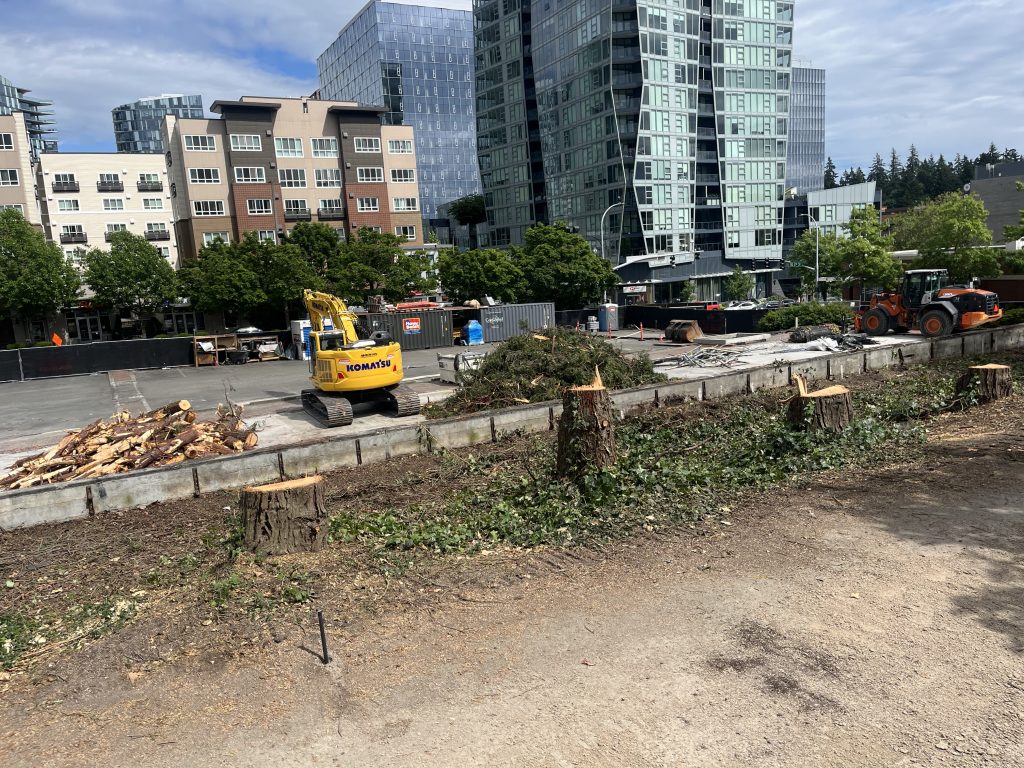
    With the removal of 29 trees along the east side of Downtown Park, the volumes created by the landscape architecture designers for the park were upended. There was formerly a shady, quiet walkway on the east side of the park, that functioned like a “room” in the park. It felt like a respite from the bustle of the city because of the sizable Port Orford cedar trees that stood there on park property until last month. 

    In addition to the removal of so many trees being a surprise*, there hasn’t been any public presentation of the future design of the landscape for the park, other than what is being shown in the promotional videos for the new building being built next door. The first floor of that new building will be somewhat elevated because of the parking garage underneath, so the place where the trees formerly stood will be replanted with smaller trees in a sloping planter that transitions the grade.

    (more…)
  • One more thing for ESC

    [7/8/26 An update has been added]

    An Environmental Services Commission meeting will be tonight at 6:30pm at City Hall, and here’s one more thing I hope they talk about there.

    Another aspect of the new information about DFCCs is that there could be some pretty large buildings affected (I had thought that it was mostly outlying areas, but it was clarified that many DFCCs exist for Downtown and Wilburton too.)

    (more…)
  • Letter about tree credit change for SR-1 areas

    This letter from a community which would be affected by the “non-controversial” changes proposed as part of the Omnibus code change was compelling to me. It is disappointing that something with obvious drawbacks like this was included in the Omnibus, since the Omnibus includes other major changes to the large development approval process that I think the Planning Commission should have had more time to focus on. The SR-1 zoning classification is new since 2024, and is equivalent to R-2.5.

    Since the tree credits cost $1300 per credit and the difference between the current and proposed requirement is 2.5 tree credits per 1000 SF of lot area when there are more than two homes on a lot, a 13,500 SF lot would save $45,500 by reducing their contribution to city-wide replacement tree planting if this change passes, and if they are able to keep or plant trees that meet the requirement, they are not charged anything.


    Dear Mayor Malakoutian, Deputy Mayor Hamilton, Councilmembers Bhargava, Briar, Nieuwenhuis, Robinson, and Sumadiwirya, 

    Thank you for considering this request. We also appreciate Nick Whipple’s detailed response explaining the implementation concerns staff has identified on certain SR-1 projects. We understand that the City should examine requirements that may have produced disproportionate outcomes, including unusually high replacement-tree obligations or fees. We are not asking the City to disregard those implementation concerns. 

    However, our concern is whether a uniform citywide reduction in SR-1 tree-credit requirements appropriately accounts for the substantially different conditions present in East Kelsey Creek.  Staff’s explanation refers specifically to SR-1 lots that are 13,500 square feet in size. In contrast, Wilburton properties North of NE 8th Street include parcels exceeding one acre. These properties include mature canopy, connected private yards, and environmental conditions associated with the Kelsey Creek watershed. Those parcels are substantially larger than the 13,500-square-foot SR-1 minimum lot area described in staff’s explanation and also larger than the 35,000-square-foot LL-1 minimum lot area shown in the City’s dimensional chart.

    (more…)
  • Clarifications on the Proposals being considered by ESC tonight

    [A new post on this topic was added on July 2nd]

    The Environmental Services Commission (ESC) meeting is today, June 18th, at 6:30pm, so here is the quick update (I was able to get some clarifications from staff yesterday). 

    Proposal #1: No more DFCCs to cover the costs of system expansions such as sewer extensions. There are also separate latecomer agreements that are not within the scope of this change. 

    Big clarification here: While eliminating the localized charge will mean that some new buildings which are easy to connect to the system will somewhat subsidize projects that would have paid more for a system extension to reach them, this is not a blank check for super ambitious connection projects (I was worried about subsidizing growth in our newly upzoned Critical Areas like wetlands and steep slopes). The city’s Utilities team doesn’t go around adding extensions in every place growth is happening, and they have discretion for prioritizing projects that make sense, which might just be a small stub to provide service for a group of existing homes. Many DFCCs are actually in places like Downtown, BelRed, and Wilburton. If there is a place where a builder wants to have service reach a previously undeveloped area, they’d pay that cost and then could ask neighboring properties to reimburse them with latecomer charges once those connect using the extension as well. 

    Proposal #2: Simpler Calculation using pipe diameter at the meter instead of calculating a Single-Family Equivalent based on the number of sinks and toilets, etc.

    My primary question about the annual fiscal impact is still unanswered, and since the ESC meeting is today, I don’t think we’ll have a number in time for the ESC vote (though we can still say it’s no more than $5M a year). This can probably be calculated before City Council makes a final decision on the policy, at least. From one perspective, the financial impact of Proposal #2 is just a rounding error, but the budget is pretty massive, so that statement alone doesn’t really clarify the scale for me. There are various ways to come up with a fair distribution of system cost, and much of the expense is in the distribution network, even more than the reservoir expansions that we will be spending several million on (to add capacity for Wilburton, etc). Part of that distribution network cost is having larger pipes to handle peak flows, fire suppression capacity, etc. 

    I’m still not convinced that a group of homes in a neighborhood is more peaky/variable than an equivalent number of toilets, sinks, and showers in an apartment building, but staff also points out that the average usage per fixture is slightly higher in a single family setting than an apartment setting. This will also raise the portion paid by businesses such as a car wash, which might only have one bathroom or a small number of sinks that would have been factored into the old calculation; now they will pay a greater share to connect when a new carwash is built or a carwash’s supply line size is upgraded to a larger diameter. Even though the CRC typically brings in several million dollars a year, this is money they don’t count on for the budget, since there could be a downturn in construction at any time and it’s important to be conservative.

    I’ll follow up with the fiscal impact question, and appreciate having gained this additional background on how it could be argued that the change in CRC calculation is fair.  

    Proposal #3 Pay Once Upfront – instead of being added to the utility bill over a span of ten years, have the charges paid at the time of permitting – this should not discourage development if paired with a cut in the fees per Proposal #2, and will eliminate surprise costs for new residents.

    A disclosure requirement neatly solves the surprise bill issue without discouraging housing production or displacing the burden onto other utility customers.  This is not solely a utilities question, since I think it’s important for potential tenants to know what costs they can expect. Again, this would cover a wide range of potential expenses that may be related to “valet” trash pick up, mail/package delivery, utility usage for common areas, technology/connectivity fee, doorknob/lock operation fee, keyfob issuance and replacement fees, pet fees, payment portal fees, tenant portal fees, lease renewal fees, credit bureau reporting fee, lease name change fee, and the duration and cost of the utility connection fee.

    If you are interested in learning more about Utilities in Bellevue, you can attend the Environmental Services Commission meeting at City Hall (in-person where parking is free, or virtually) and there is an opportunity for public comment at the beginning of the meeting. There is an email where you can send written comment, but as noted in my last post, you probably have to get your comment in the week before the meeting if you want them to see it (and that’s tight when the agenda materials may only come out the week before). I’d also recommend this recording of the Community Meeting on the Utilities Budgets and Rates, which was held last week. https://www.youtube.com/watch?v=6skhCoahhbs

    I’ll be following other developments, as we can expect some additional changes due to the changes in meter reading – it makes monthly bills feasible, and this may also allow a change in which months are used for the winter baseline estimate.  This ESC meeting will also include an update on the expected cost increases; utility charges are expected to go up 54%, sewer by 79%, and stormwater utility charges by 42% in the 2027-2032 timeframe. 

  • Open letter to Environmental Services Commission

    [A new post on this topic was added on July 2nd]

    I am partly posting these because this is the spot I will add more info/follow-up – the Commissioners were not given the emails I sent before their previous meeting on 6/4/26, and it is unfortunate that the Commission’s inbox does not enable timely communication.

    I hope this is also useful context for anyone who may attend the Thursday, June 11, Community Meeting about Utility Budgets and Rates, virtual, 6pm (link) – Proposed utility budget and rate updates, Infrastructure and capital improvement projects, Financial planning and affordability considerations, and Customer assistance resources. Hopefully we can get some of these questions answered then, though I can’t guarantee I’ll be able to attend myself.

    The Environmental Services Commission will be considering changes to Utility Connection Charges specifically at their next meeting on June 18th at 6:30pm. If you have comments to them that you don’t get a confirmation were forwarded, you can also forward them to me, and I could make a separate post for those.

    (6/18/26)A new post is here, and happily, I’ve received important clarification is on Proposal #1 that significantly reduces my concerns.

    (more…)
  • Paying for the Grand Connection

    The headlines usually say that the Grand Connection “has been funded,” but even with the recent progress on generating $41M (in present value dollars) through the Tax Increment Financing (TIF), and the allocation of $2M from the federal government, there’s still a big gap in covering this $200-225M project. I attended the recent special meeting of the City Council on May 20th where the TIF was approved, and I was the only member of the public present. This level of public engagement is not in line with the budget impacts these decisions will have on Bellevue’s future, so I wanted to share more info before the City Council votes to award the Grand Connection work to contractors on June 2nd. 

    The city’s current plan is to activate the previously approved Transportation Benefit District (TBD) sales tax to fund approximately 40 percent (approximately $141.4 million) of the Grand Connection Crossing total cost (principal and interest associated with debt issuance). Additional funds would be from Tier 2 funding sources (philanthropic private funds and dedicated/specific funds of the city) representing approximately 36 percent of the total Grand Connect Crossing cost (approximately $127.8 million). TIF would support the remaining amount 24 percent of the total costs ($84.4 million, present value $41.0 million) (see pages 8 and 81 of the Final Project Analysis). 

    By activate, it means Bellevue will start charging an additional 0.1% sales tax. Approximately half of the TBD sales tax revenue might go to supporting the Grand Connection if we assume a consistent amount is used for bond payments over the 25 years, and there might still be another ~$5M annually for other transportation needs in Bellevue.  

    That $127.8M is a big chunk of the project cost, so it would be nice to know how much of that will come from donations and how much from city funds. There is a group called Friends of the Grand Connection that is responsible for raising philanthropic funds to support the project. It is should be considered, though, that any funds raised may reduce contributions toward other important projects in Bellevue. For instance, Amazon donated $5M toward the $43M cost of the Wilburton Trestle work. 

    The dedicated/specific city funds category might mean that funds which would have gone to other sidewalk and bike route projects will instead be used for the Grand Connection. In the context of recent spending on similar improvements, the 10-block stretch of multiuse path in progress along 100th Ave NE will cost $8.3M, and the widened path on the south side of Main St. between 108th and 112th is $2.7M.  There was also a recent allocation of $748k for the Urban Core Bike Network Connections Phase 1 work (Council mtg 4/28/26), which can be compared with the Bike Bellevue plans to see how construction prices are trending (I think this last one is an example of state grant funding that might be less affected by Grand Connection spending).  On the revenue side, the curb pricing plan to charge people to park on the street is expected to raise $2.3M annually (Council mtg 12/2/25) toward curbside, wayfinding, and ADA improvements.  The new speed cameras will also generate some revenue.

    The obvious alternative would be to make a deal with Sound Transit for the segment between Downtown Bellevue and Wilburton, so that any fare enforcement that would have happened there is instead shifted to the adjacent segments, and some staffing is present to monitor for excess usage (there could be a rule that only one round-trip per hour is free). There would need to be improved signage showing the arrival of the next train and amenities like coffee windows and planted pathways on the Wilburton side to provide a sense of place for people to linger between trains, as well as ground-level and elevated connections to the new buildings. This wouldn’t provide connectivity after Link operating hours, but there might be an extension of BellHop service to cover that, and I’m not sure how many people would use the crossing in the dark anyway. The piece that would be hard to replace is the connectivity for bikes. Right now, there’s a new multiuse path along Main St (just rode on it for the first time this week!) that will provide a safe but somewhat steep route for cyclists getting off the Link at the East Main Station, and the Grand Connection of course connects to the Link at the Downtown Station. During non-peak hours, it’s easy to take a bike on the train, but as the train becomes more crowded, it may be necessary to add additional cars for cyclists to ride comfortably, and Sound Transit should probably start ordering more train cars now if we anticipate this need.  

    I could be persuaded that the Grand Connection is the right thing for Bellevue, but I think there should have been a vigorous discussion about it with the context made clear, and this short summary doesn’t even cover the other transportation needs that Bellevue anticipates needing funds for. 

  • Everything is in the newsletter

    Bellevue has had no shortage of big decisions in the works, but I haven’t always had time to make a post here or elsewhere about them. Instead, I cover them in the weekly newsletter, and if you’re not signed up, you’d be likely to miss some.

    Tonight, Council will initiate work on a major upzoning of existing housing around Crossroads and Factoria, to what is essentially R-60 zoning, and there will also be flexibility for planned unit developments and a big upzone for Overlake Farm (equivalent to R-15, so maybe 600 homes). It’s not a done deal, but speaking up early in the process may help community concerns to be factored in early on. There is also an item about upzoning the Factoria QFC and AMC and adjacent parcels to 110 feet, but that is on the Consent Calendar, so that decision is likely to be finalized tonight without any discussion.

    Planning Commission will have their hearing on Wednesday for the Omnibus changes, which will disallow single family homes in some areas (formerly R-10 through R-30), significantly reduce tree requirements (by 60% plus) in some other neighborhoods (formerly R-2.5 zoning), and streamline the project approval process for some major projects. There are some building separation changes that will only affect certain residents, and lots of other tweaks. I would be surprised if there’s much pushback, since these were first announced in the beginning of April, and many community members still don’t know about them, but that also means that if you can attend the public hearing, your voice could have a disproportionate impact.

    If you’re interested in seeing more about either of these topics, you can find the newsletter archives from the Newsletter link in the upper right.

    There were also some big decisions last week that affected our budget – moving forward with the Tax Increment Finance tool to collect money for the $200-225M Grand Connection project; assumed future revenue will be the basis for creating bonds, with anticipated bond amounts of $75 million in 2026; $80 million in 2027, and $75 million in 2028. Council also voted on $9.5M for the KidsQuest move. There was also an Environmental Services Commission meeting with early steps toward increasing residents’ utility bills by lowering the fees paid in by developers.

    The newsletter also includes the latest version of the Event Calendar and the Get Involved pages, but you can always come to this site for the most recent versions of those; they’re updated continuously as items come across my desk.