On February 24th, City Council had a preliminary vote to move forward with a proposal for HOMA upzones across the city, and an another vote that finalizes the plan will be happening on March 17th.
Housing Opportunity in Mixed-use Areas (HOMA) is a Council-initiated plan to promote residential capacity. Many of the growth-related changes are coming from the state legislature, but HOMA is specific to Bellevue only. Density will be added through rezoning, increasing heights of the zoning categories, reducing setbacks, increasing the allowable footprint of buildings, eliminating stepbacks for the upper floors, etc.
HOMA will affect neighborhood centers (Northtowne, Newport Hills, Lake Hills) and also Eastgate, Crossroads and Factoria. It is separate from work that was recently done for Wilburton and middle housing in neighborhoods and also separate from planning that is in progress for BelRed and Evans Plaza.
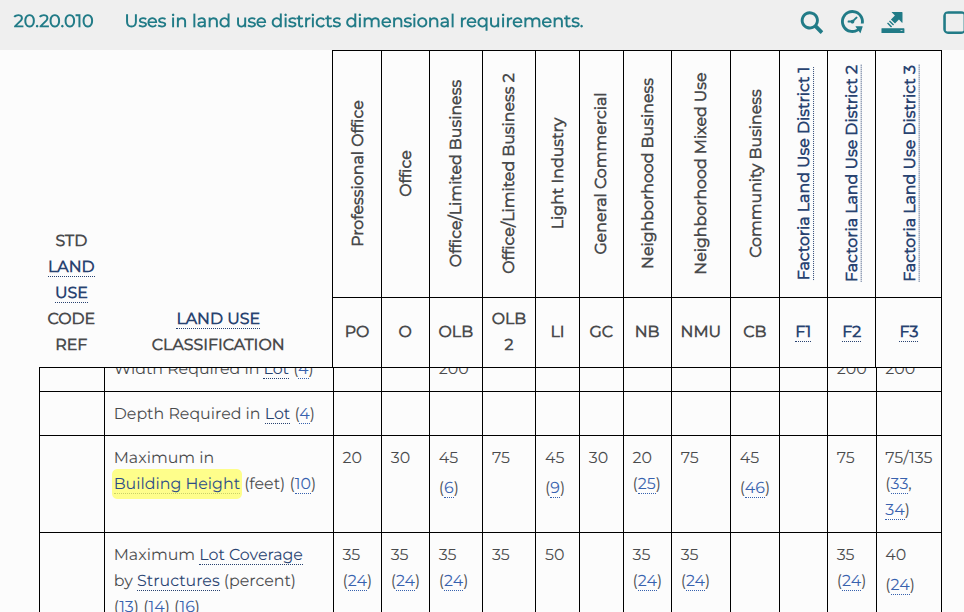
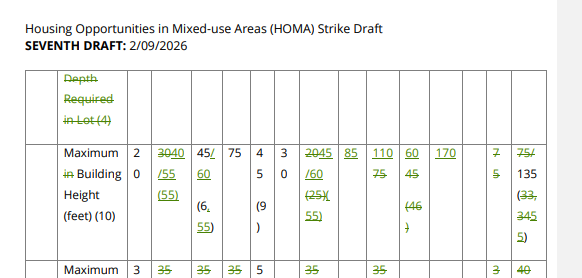
By adding height in mixed use areas, HOMA means big changes for the properties with grocery stores that Bellevue residents depend on. If the maximum height at a neighborhood center is changed from 20 to 60 feet, it is much more likely to get a new building. There would be even taller buildings allowed in the Factoria, Crossroads, and Eastgate areas (8, 10, and 16 stories), as well as at scattered locations across the city.
It has been worked on by the planning staff for over a year, but substantive changes have been made quite recently. At the end of January, Planning Commission decided the height of the MU-7 (mixed-use) category should be increased to allow 8 story buildings instead, so it will be called MU-8. On February 24th, the day of the council meeting, it turned out that the rezoning map didn’t include all the parcels that will be rezoned to allow taller buildings, so a new version was made. Some were also requesting reduced property line setbacks adjacent to single family homes so they can make their buildings larger, though this did not end up being included. At the last Council meeting about this, it was decided that stepbacks will still be required in Old Bellevue, and an opt-in provision and exemption for the floor plate increase were added.
It is concerning that neighbors, especially near the neighborhood centers, have not been informed that they may lose the small businesses* they depend on, and that other impacts on the immediate neighbors have not been adequately explained to them (setbacks are likely to determine how much adjacent properties are affected). The community should participate in the process of deciding which amenities would justify a height increase like this. People may want space for small businesses, continued access to groceries, and childcare space, etc.
To put this in context, here are the heights** on parcels with grocery stores that would be allowed under HOMA, and their zoning:
QFC in Northtowne (NB, 20 feet -> 45/60 feet)
S-Mart in Newport Hills (NB, 20 -> 45/60 feet)
Crossroads:
India Metro Hypermarket (CB (was 45 feet)->NMU, 110 feet)
La Superior (CB, 45 -> 60 feet)
European Grocery (CB, 45 -> 60 feet)
Grocery Outlet (O (was 30 feet) ->NMU, 110 feet)
(other parts of the mall are being changed to NMU and MU16, which will be 110 and 170 feet)
Walmart by 150th (CB (was 45) -> MU-8, 85 feet)
Factoria:
T&T Supermarket (F-1, subcategory DA-I and DA-II, from 60 and 40/75 to 170 feet and 80 feet)
Target and former Amazon Fresh (F-1, subcategory DA-I, 60 -> 170 feet)
QFC (CB, 45 -> 60 feet)
Southgate Oriental Grocery (CB (was 45) -> NMU, 110 feet)
Eastgate Plaza’s Safeway and CVS, as well as the ExtraMile and Jacksons Food Store (NMU, 75-> 110 feet)
Lake Hills:
IFB Market (CB (was 45) -> MU8, 85 feet)
QFC (NB, 20 -> 45/60 feet)
There is also a Safeway on 140th in BelRed. Since it is just east of the section of BelRed that will likely become 250′ under the BelRed Look Forward LUCA, I believe it will stay as a Mixed Use Midrise (MU-M) at 100′ – but with an additional 45′ to provide building height flexibility in the case of life sciences uses (pages 18 and 20 of that LUCA draft).
*HOMA does include incentives for providing space for grocery stores and affordable commercial space, childcare space, and space for non-profits (page 138 of the draft), but it is not clear whether they are generous enough to result in the construction of that space. FAR exemptions can provide for a larger building only if the project is not already filling the maximum volume possible given the height cap and required setbacks.
** Where there are two numbers, like 45/60, the higher of the two is allowed if a small contribution is made to the affordable housing fund for each unit, $1.50 or $1.95 per sqft of a residential building (see page 66 and note (55) on page 78 of the draft).
Note: SB 6026 (currently on the Governor’s desk) had previously required the city to allow buildings to get a 10’ height bonus in areas where we chose to require ground floor commercial space, but that height bonus was taken out by the Ways and Means committee, so I don’t think it ended up in the final version. Still, things like this could easily be added at the state level next year, which we should be mindful of in our local planning.
Note: There are still some things I’m not sure about – for instance, the deletion of the “DT-Tower” definition on page 111 of the draft may mean that the Tower Separation distances in 20.25A.075.B also apply to buildings that are under 100 feet, or maybe the requirement goes away entirely.
3/17 update to Note: received clarification that the DT-tower definition appears more than once, so it was considered redundant and this should not change anything.